The Best Plants for a Beginner Aquascape (and How to Use Them)
Why Plant Choice Makes or Breaks a Beginner Aquascape
The plants you choose at the start will determine whether your aquascape thrives or slowly falls apart. Pick the wrong species and you'll spend weekends battling algae, replacing dead plants, and wondering what went wrong. Pick the right ones and the tank largely takes care of itself.
Live plants do more than look good. They compete with algae for nutrients, oxygenate the water, and give fish and shrimp natural cover. In a low-tech aquascape — no pressurized CO2, no high-wattage lighting — the species you select need to be genuinely tolerant of those conditions, not just marketed as "easy."
The good news: a handful of plants have been proven across thousands of beginner tanks to be nearly indestructible, widely available, and visually striking. This guide covers exactly those plants, where to place them, and how to arrange them so your first aquascape looks intentional rather than accidental.
What Makes a Plant "Beginner-Friendly"?
A beginner-friendly aquatic plant tolerates low to medium light, grows without CO2 injection, and survives the water parameter swings that are normal in a new tank. Those three traits together are rarer than you'd think.
Here's the practical checklist worth applying before buying any plant:
- Low to medium PAR lighting — thrives under standard LED aquarium lights without a high-output upgrade
- No CO2 injection required — absorbs enough dissolved CO2 from fish respiration and surface agitation
- Tolerates pH and hardness variation — doesn't melt or stall when parameters shift slightly
- Easy to source — available at most fish stores or online, and affordable enough to replace if something goes wrong
- Slow to moderate growth — fast growers like hornwort are fine, but they need regular trimming; factor that into your maintenance expectations
Plants that require high light, injected CO2, or a specific nutrient-rich substrate are not beginner plants regardless of what the label says. HC Cuba and glossostigma are beautiful — and genuinely difficult. Save them for your second or third tank.
Best Foreground Plants for a Natural Layout
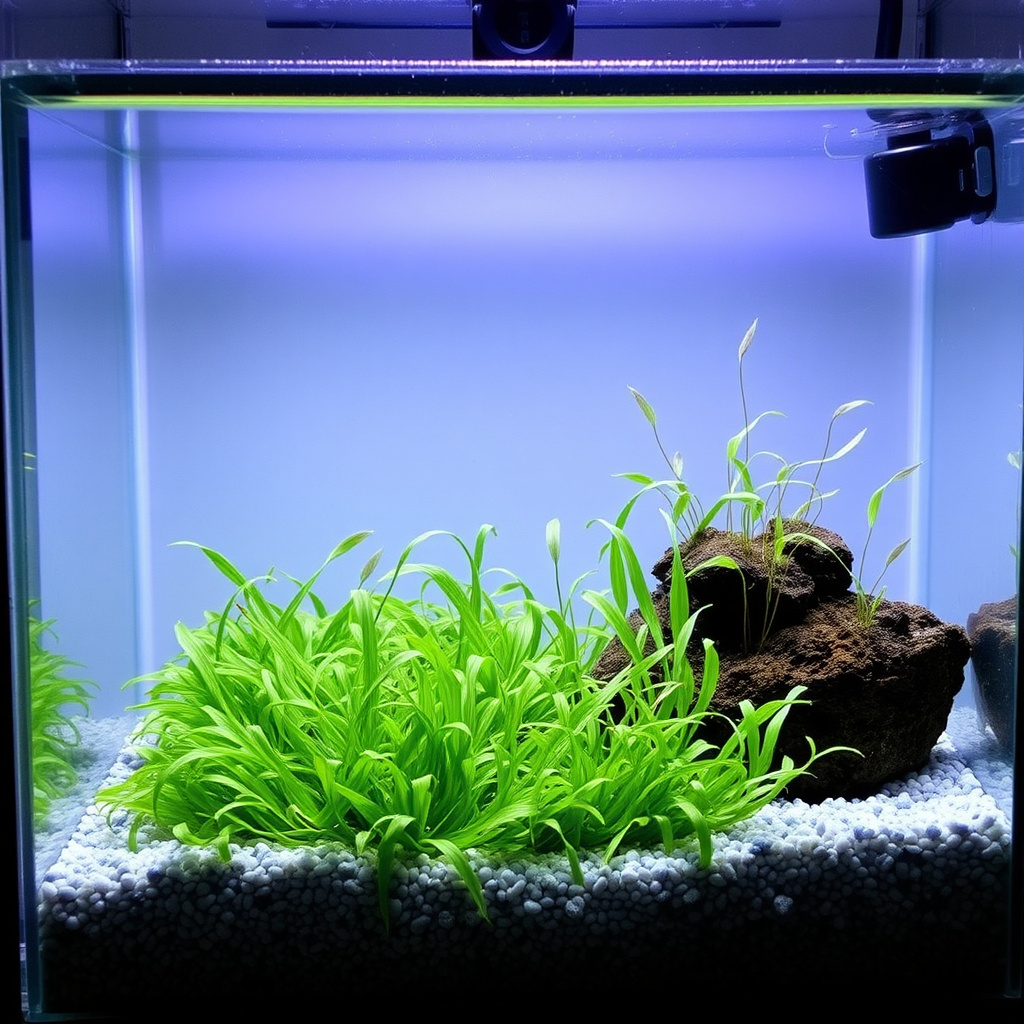
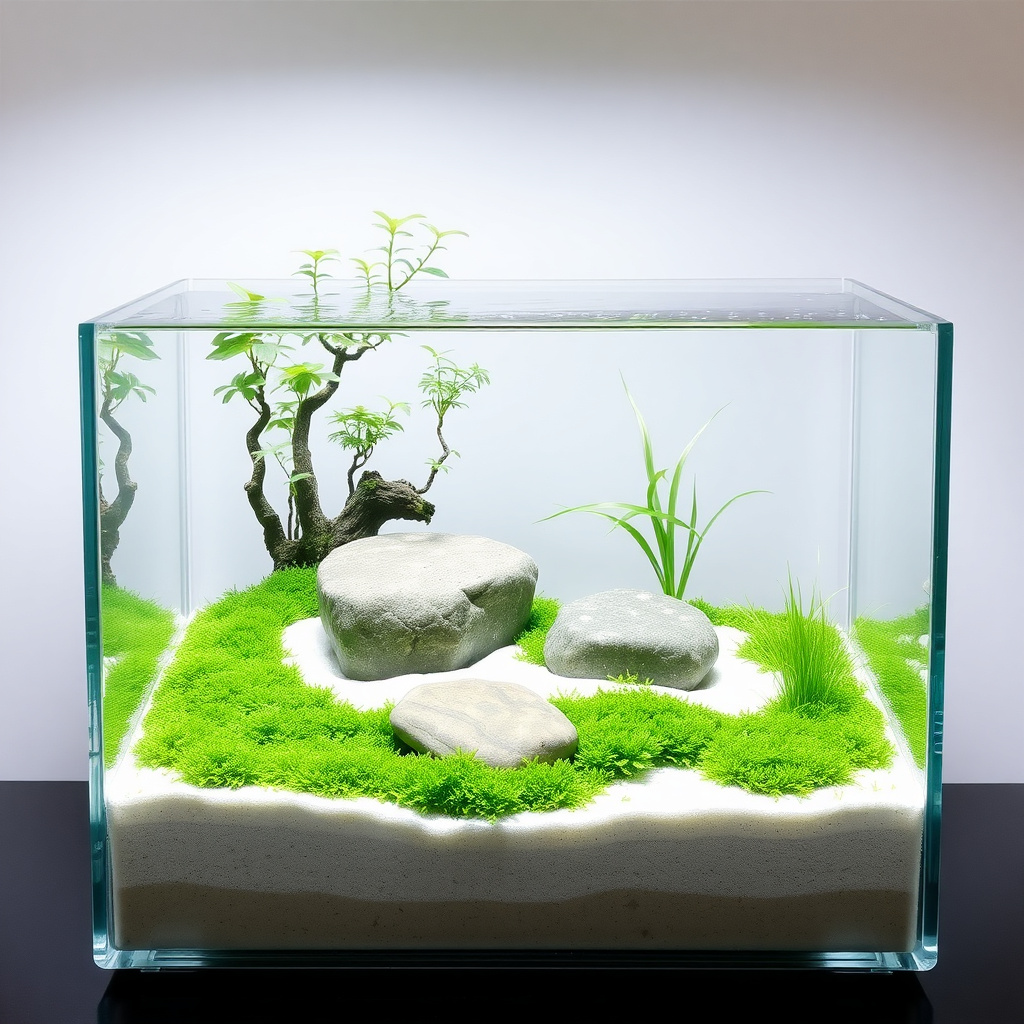
For the foreground of a beginner aquascape, Dwarf Sagittaria (Sagittaria subulata) and Java Moss (Taxiphyllum barbieri) are the two most reliable choices. Both stay low, spread naturally, and work in low-tech setups.
Dwarf Sagittaria
Dwarf Sagittaria grows as a grass-like carpet, reaching 5–15 cm depending on light levels. Under low light it stays taller and more open; under medium light it spreads more densely via runners. Plant individual stems about 3–4 cm apart in the substrate and let it fill in over 4–8 weeks. It's one of the few true carpeting plants that doesn't demand CO2 or high PAR — a genuine exception in that category.
Java Moss
Taxiphyllum barbieri is almost impossible to kill. Attach it to small stones or driftwood fragments in the foreground, or let it grow loosely across the substrate for a naturalistic, overgrown look. It also works as a transition element between hardscape and open substrate. Shrimp love it — the dense structure provides grazing surface and shelter, which matters if you're planning a planted shrimp tank.
Best Midground and Background Plants for Structure
Amazon Sword (Echinodorus bleheri) and Hornwort (Ceratophyllum demersum) are the workhorses of the midground and background in a beginner tank. They add height, fill empty space, and grow reliably without a high-tech setup.
Amazon Sword
Amazon Sword is a heavy root feeder, so it performs best when planted in a nutrient-rich substrate or supplemented with root tabs placed near the root zone. A single mature plant can spread 40–50 cm wide, so give it room — it's a centerpiece plant, not a filler. Place it slightly off-center in the background for the most natural composition. New leaves may melt back after planting (a normal transition response), but the plant rebounds within a few weeks once roots establish.
Hornwort
Hornwort grows fast — sometimes aggressively fast. That's actually useful in a new tank because rapid plant growth suppresses algae during the cycling period. You can plant it in the substrate or leave it floating; floating hornwort grows even faster and shades the tank slightly, which can help if you're dealing with early algae issues. Trim it regularly or it will dominate the background within a month.
Best Plants to Attach to Hardscape (Wood and Rock)
Anubias and Java Fern are the two plants every beginner should know. Both attach to driftwood and rocks rather than rooting in substrate, which makes them uniquely versatile for aquascape hardscape arrangements.
Anubias (Anubias barteri)
Anubias barteri is slow-growing, broad-leaved, and nearly indestructible. Tie or glue it to driftwood or stone using cotton thread or aquarium-safe gel. The rhizome — the horizontal stem from which leaves emerge — must stay above the substrate. Bury it and the plant rots. Anubias tolerates very low light, which makes it ideal for shaded spots behind rocks or under wood overhangs. Its dark green leaves contrast well against pale substrates and lighter-colored hardscape.
Java Fern (Microsorum pteropus)
Microsorum pteropus has a distinctive textured leaf that adds visual depth no stem plant can replicate. Like Anubias, it attaches to hardscape and should never be buried in substrate. Java Fern propagates by growing tiny plantlets on the edges of mature leaves — when those plantlets develop roots, you can detach them and attach them elsewhere. It's one of the few plants that actually reproduces itself in a low-tech tank without any intervention.
How to Arrange Plants for a Balanced Aquascape
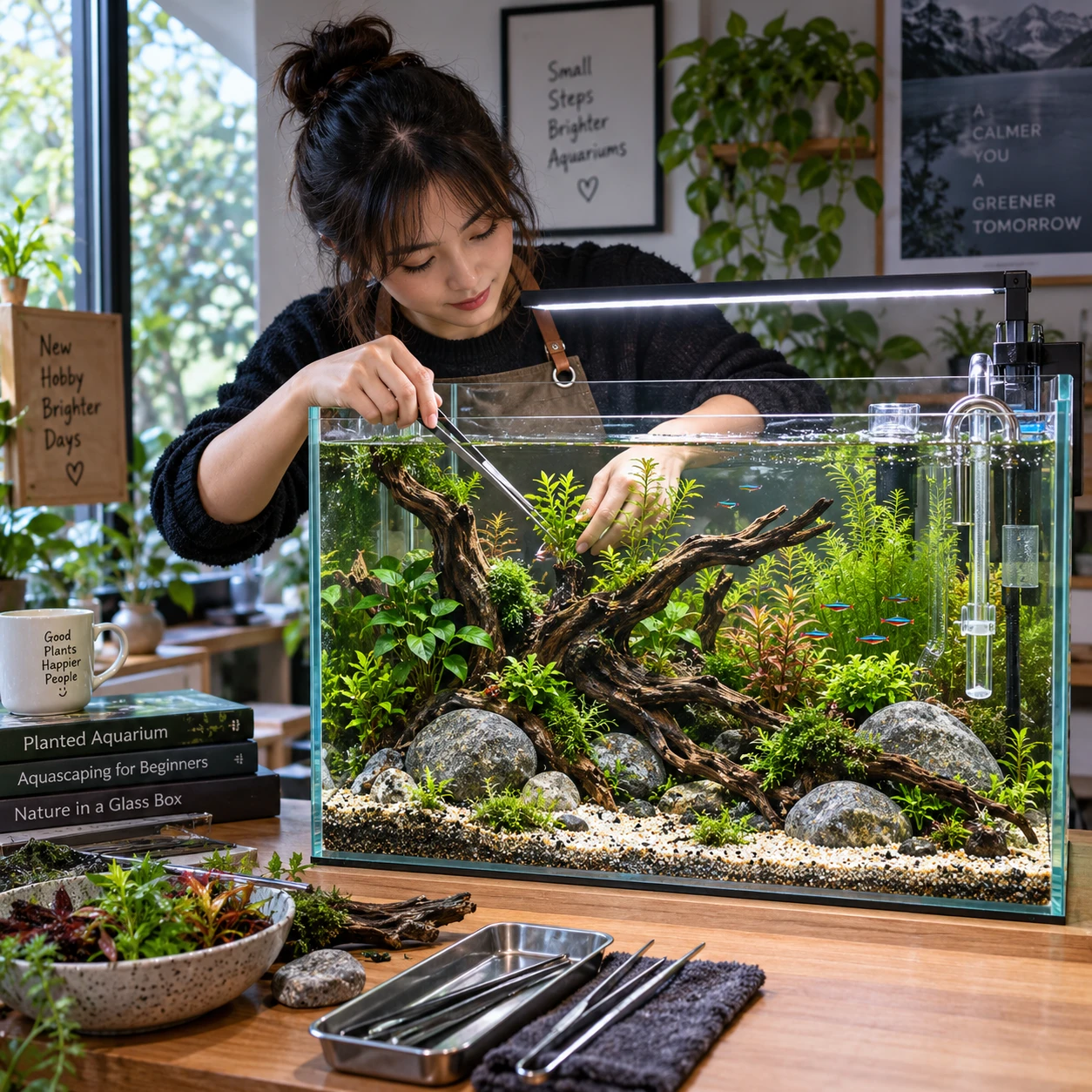
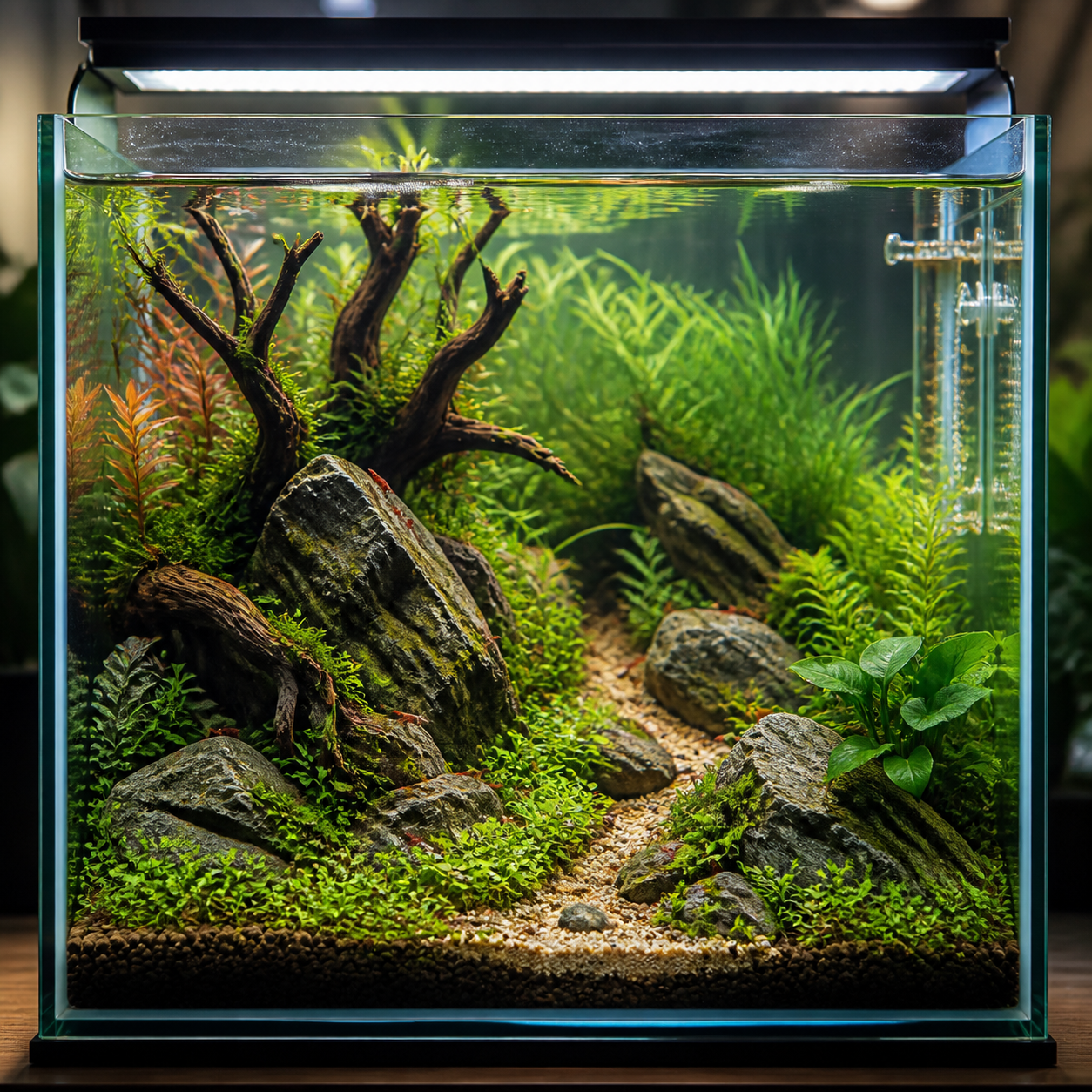
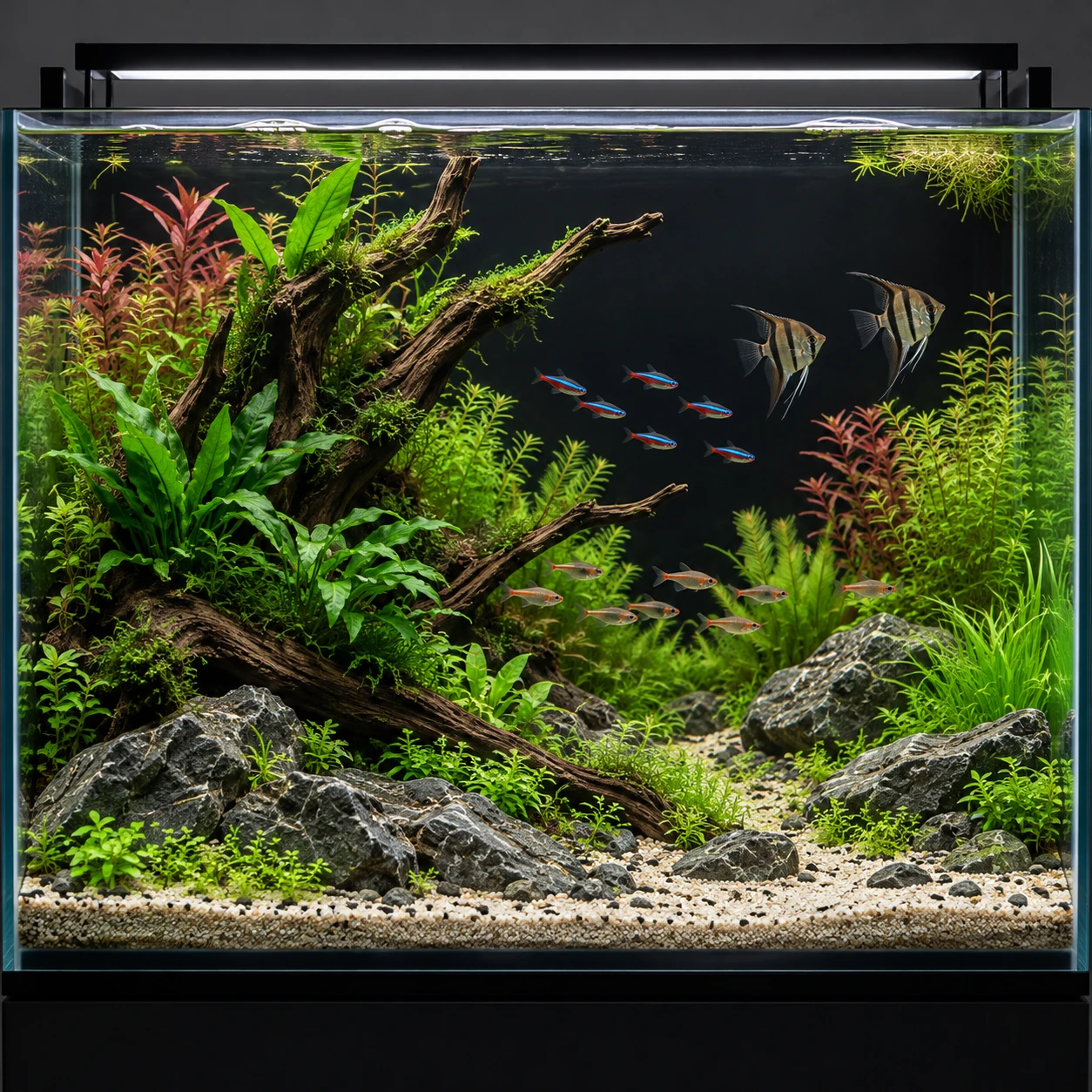
A balanced aquascape uses the foreground, midground, and background zones to create depth and visual flow. The basic rule: short plants in front, tall plants in back, with midground elements bridging the two.
In practice, that means placing Dwarf Sagittaria or Java Moss at the front glass, Amazon Sword or Hornwort along the back wall, and Anubias or Java Fern on hardscape in the middle zone. This layering creates the illusion of depth even in a small tank.
Two compositional principles worth applying from the start:
- Rule of thirds — place your main focal point (a large piece of driftwood, a specimen Amazon Sword) one-third from the left or right rather than dead center. Centered compositions look static.
- Negative space — leave some open substrate visible. A tank packed wall-to-wall with plants looks cluttered, not lush. Open sand or gravel areas give the eye somewhere to rest and make the planted sections look more intentional.
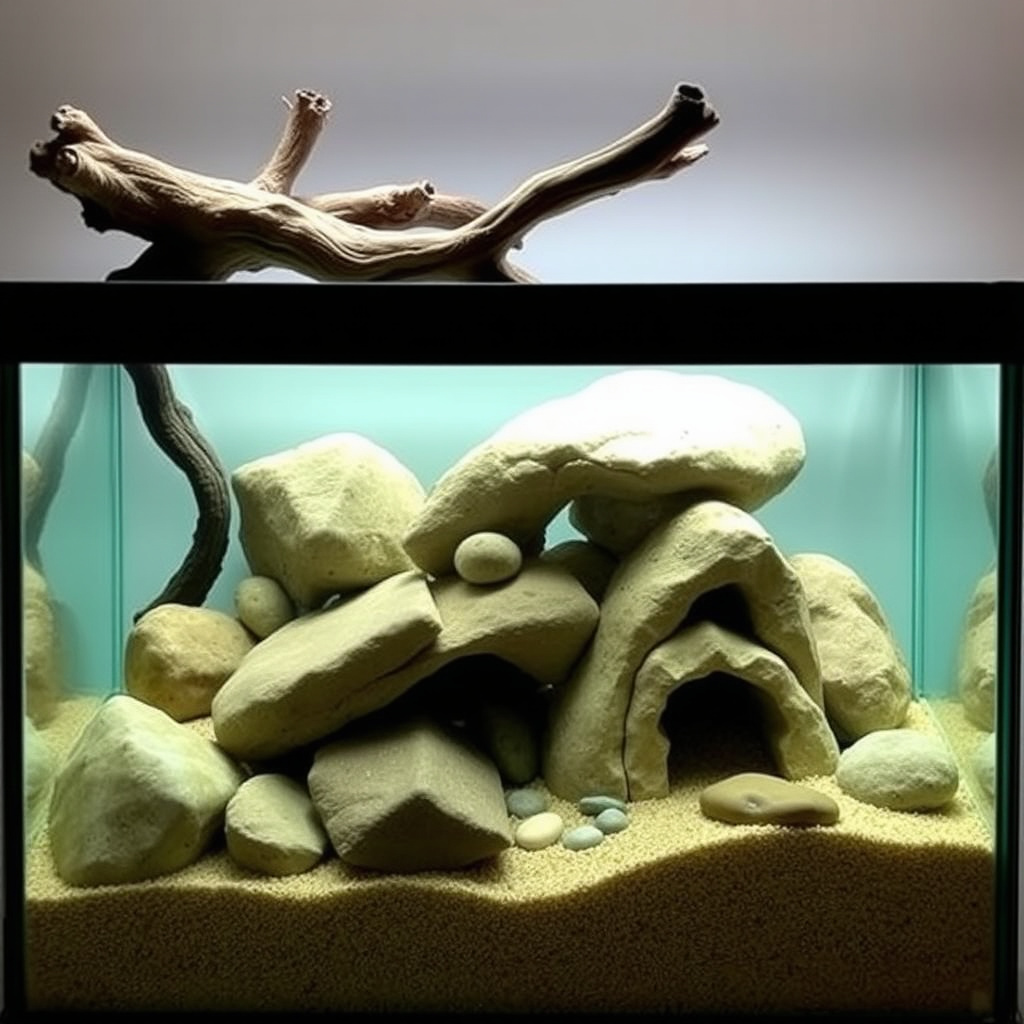
Hardscape elements like driftwood and rocks should be placed before plants. Build the structure first, then fit plants around it. Anubias and Java Fern are particularly useful here because you can position them precisely on specific surfaces rather than being constrained by where substrate is available.
Common Beginner Mistakes to Avoid
Most beginner aquascape problems trace back to a small set of recurring errors. Knowing them in advance saves a lot of frustration.
Burying the Rhizome
Both Anubias and Java Fern have rhizomes that must stay exposed above the substrate. Burying them — a natural instinct when planting — causes the rhizome to rot within weeks. The plant yellows, leaves detach, and the whole thing dissolves. Always attach these plants to hardscape or rest them on top of the substrate with only the roots buried.
Overcrowding at the Start
New hobbyists often plant densely to get an immediate lush look. The problem is that plants need room to grow, and overcrowding leads to shading, poor water circulation, and die-off in the lower canopy. Start with 60–70% of your intended plant density and let the tank fill in naturally over 6–8 weeks.
Mismatched Lighting
Running high-output lighting over a low-tech tank without CO2 is one of the most reliable ways to trigger a green algae explosion. More light means more photosynthesis demand — if plants can't keep up because CO2 is limited, algae fills the gap. Stick to low to medium aquarium lighting (roughly 20–40 PAR at the substrate) for a no-CO2 setup.
Skipping Fertilization
Low-tech doesn't mean no nutrients. Root-feeding plants like Amazon Sword deplete substrate nutrients within a few months. Use root tabs every 2–3 months near heavy root feeders, and consider a diluted liquid fertilizer for water-column feeders like Hornwort. Plant-safe fertilizers formulated for aquariums won't harm fish or shrimp at recommended doses.
Frequently Asked Questions
Can I grow aquascape plants without CO2 injection?
Yes. All the plants in this guide — Java Fern, Anubias, Java Moss, Amazon Sword, Hornwort, and Dwarf Sagittaria — grow without pressurized CO2. They absorb dissolved CO2 naturally present in the water from fish respiration and surface gas exchange. CO2 injection accelerates growth and can improve color, but it's not required for a healthy low-tech aquascape.
How much light do beginner aquarium plants need?
Most beginner-friendly plants thrive under low to medium light — roughly 8–10 hours per day from a standard LED aquarium fixture. Avoid running lights longer than 10 hours, as extended photoperiods promote algae without benefiting plants meaningfully. A simple timer keeps the schedule consistent.
Do I need a special substrate for aquatic plants?
Not necessarily. Java Fern, Anubias, and Java Moss don't root in substrate at all. Amazon Sword and Dwarf Sagittaria benefit from a nutrient-rich aquasoil or from root tabs added to plain gravel. Plain gravel or sand works fine for most beginner plants as long as you supplement with root tabs for heavy feeders.
How fast do beginner aquascape plants grow?
Growth rates vary. Hornwort can add several centimeters per week under decent light. Amazon Sword puts out a new leaf every 1–2 weeks once established. Anubias is famously slow — one new leaf per month is typical. Java Moss grows steadily but not aggressively. None of these require constant trimming except Hornwort.
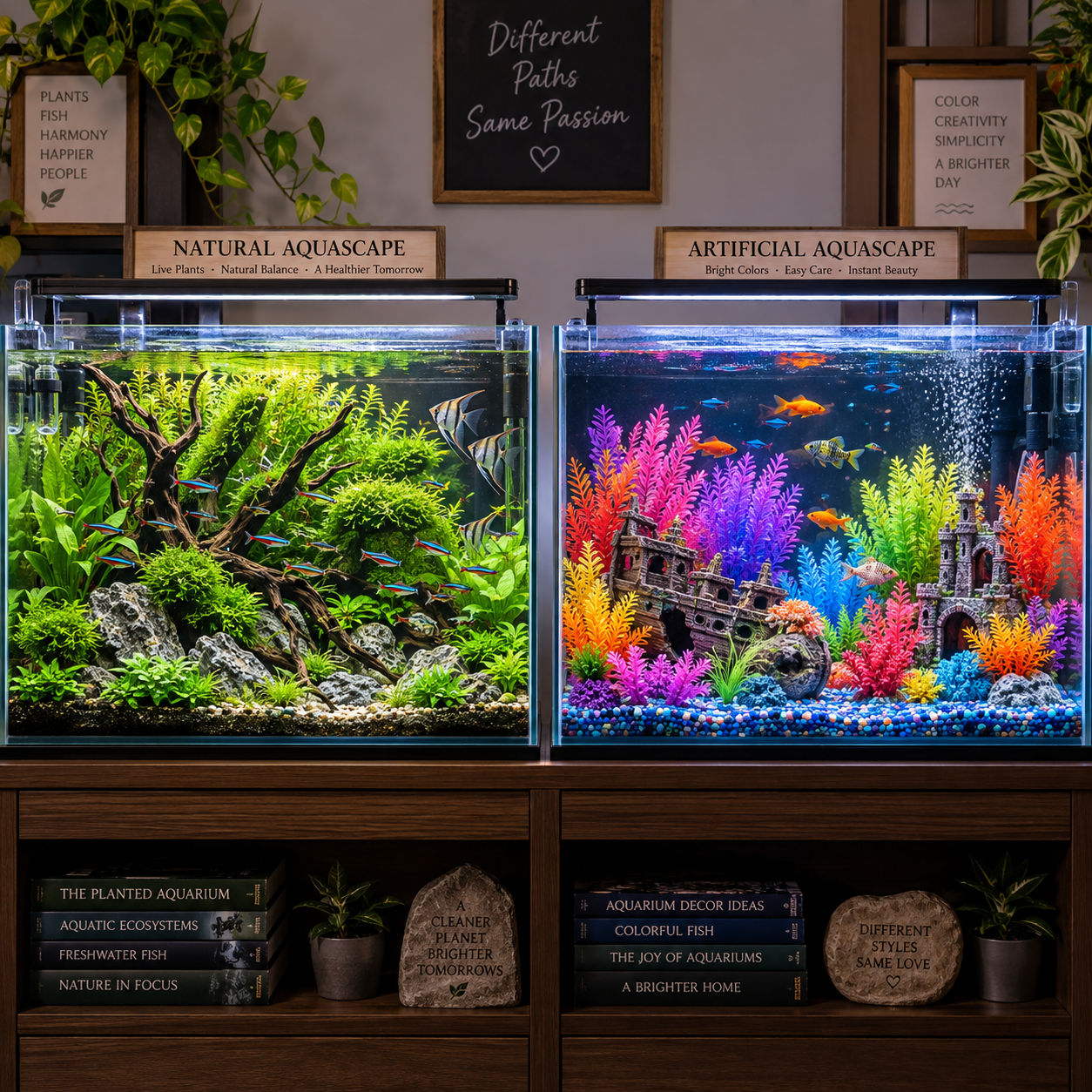
Can I mix live plants with artificial aquarium decor?
Yes, and it can work well aesthetically. Artificial rocks, resin ornaments, and decorative substrates pair naturally with live plants — the plants add movement and biological function while the decor provides structure and visual interest. Just make sure artificial pieces don't leach chemicals into the water. Aquarium-rated decor is safe; painted or unsealed craft materials are not.